

Materials Science Explainer
Why Some Metals Melt in Your Hand
Gallium turns from a solid into a liquid at a temperature just below that of human skin, and its crystal structure helps explain why.
Why some metals melt in your hand comes down to a short list of unusual elements, and gallium is the best-known of them. Most people picture metals as hard, heat-resistant materials, yet gallium is a soft, silvery-white metal that is solid at room temperature and can liquefy in the palm of a hand. Its melting point sits at about 29.76 °C (85.57 °F), only a little above typical room temperature, which is lower than normal human skin temperature. A handful of other metals also become liquid near everyday temperatures, and looking at them side by side shows how varied the behavior of metallic elements can be.
The Gallium Melting Point: A Metal Just Above Room Temperature

The melting point of gallium is listed as 29.7646 °C (85.5763 °F), or 302.9146 K. That figure is close to the average summer daytime temperatures in Earth’s mid-latitudes, according to Wikipedia’s summary of the element. The value is precise enough to have a formal job: the melting point of gallium is one of the defining temperature reference points in the International Temperature Scale of 1990, which was established by the International Bureau of Weights and Measures.
Gallium has been known since 1875, and its low melting point has made it useful for alloys that liquefy at modest temperatures. The same source notes that gallium’s boiling point, 2676 K, is nearly nine times its melting point on the absolute temperature scale, which it describes as the greatest ratio between melting and boiling point of any element. In other words, gallium becomes liquid very easily but stays liquid across an unusually wide temperature span. Los Alamos National Laboratory, quoted by Discovery, says it has one of the longest liquid ranges of any metal.
Fact box
Gallium (symbol Ga): melting point 29.7646 °C (85.5763 °F). Known since 1875. Its melting point is an official reference point on the International Temperature Scale of 1990.
Why Gallium Melts So Easily: Crystal Structure and Weak Metallic Bonding

The reason for gallium’s low melting point lies in how its atoms are arranged. Solid gallium has an orthorhombic crystal structure, and one popular science account describes the atoms as forming pairs, known as Ga₂ dimers, with relatively weak interactions between neighboring atoms. Wikipedia’s entry on gallium says this structure explains why gallium melts at a much lower temperature than its neighbors in the periodic table, aluminium and indium.
The contrast with aluminium is large. Aluminium melts at 660.32 °C (1220.58 °F), according to a gallium guide from UDTECH, while gallium gives way at less than 30 °C. The two metals sit next to each other in the same column of the periodic table, so the gap shows that position in the table alone does not determine how readily a metal melts.
Melting points of three metals (°C)
How Body Heat Melts Gallium in Your Palm
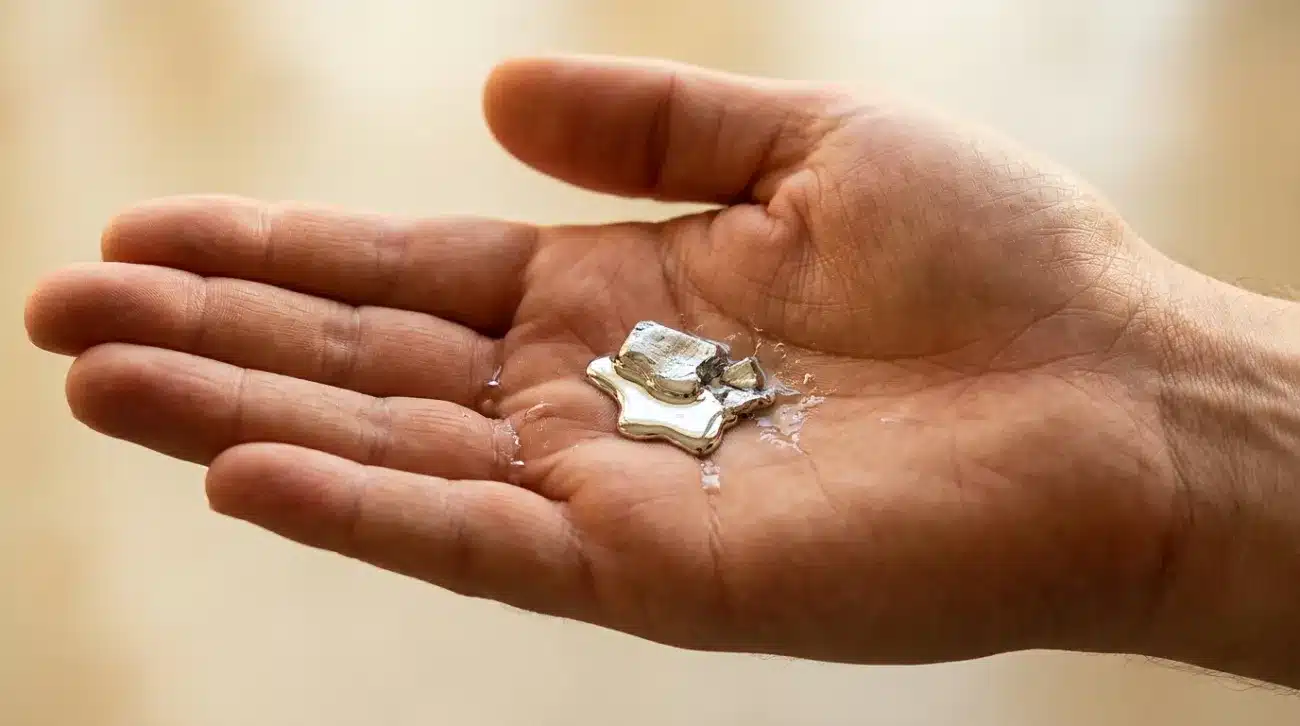
Human skin is usually warmer than gallium’s melting point. One science blog gives a typical skin temperature range of 32 to 35 °C, and a machining-industry guide cites an average of about 33 °C. Both figures are above 29.76 °C, so heat flows from the hand into the metal. The Museum of Science has described gallium as melting at about 86 °F (30 °C), just below body temperature.
The process is not instant. A science-education page from Beal’s Science explains that the hand touches only one part of the piece, so that part heats and liquefies first while the rest stays below its melting point and remains solid. A large chunk can therefore take a while to melt completely. The same behavior runs in reverse: gallium that has melted in a hand will solidify again once it is removed and cools, as Wikipedia notes.
Other Liquid Metals Near Room Temperature: Mercury, Cesium and Rubidium

Gallium is not the only metal that approaches liquid at everyday temperatures. Quoting Los Alamos National Laboratory, Discovery reports that gallium is one of four metals, along with mercury, cesium and rubidium, that can be liquid near room temperature. Mercury is the one most people know. Its melting point is −38.83 °C (−37.89 °F), according to UDTECH, so it is already liquid at ordinary room temperatures, unlike gallium, which needs a little warmth to flow.
That means “melts in your hand” applies to gallium in a way it does not apply to mercury, which never needs to be warmed at all. Gallium also differs from mercury in how it is handled: sources describing pure gallium say it is harmless to touch, though it can leave stains on skin and surfaces. Detailed comparisons of the physical reasons behind each of the four metals’ behavior go beyond what the sources reviewed for this article state, so they are not covered here.
Context box
Mercury is liquid at room temperature on its own. Gallium needs a little warmth, and skin supplies it. Cesium and rubidium are the other two metals that Los Alamos National Laboratory, as quoted by Discovery, lists as liquid near room temperature.


