

Gallium Alloys, Supercooling and Safe Handling

Mixing gallium with other metals can lower the melting point further. Galinstan, an alloy of gallium, indium and tin, is claimed to have a melting point of −19 °C (−2 °F), well below the freezing point of water. Wikipedia adds a caution, however: that figure may actually be a freezing point affected by supercooling, a state in which a liquid stays liquid below the temperature at which it would normally solidify. The reported value should therefore be read as a claim rather than a settled constant.
Gallium’s properties also change sharply near its melting point. Wikipedia reports that the coefficient of thermal expansion increases by several hundred percent when the metal melts. The metal has practical side effects as well. Los Alamos National Laboratory, again as quoted by Discovery, says gallium wets glass or porcelain and forms a brilliant mirror when painted on glass. One science blog warns that gallium wets and penetrates other metals, especially aluminium, and says it can weaken aluminium structures, so it should not be spilled on aluminium objects such as laptop casings or aircraft components. Anyone handling it should expect stains on skin and surfaces.
Beyond the Party Trick: Where Gallium Matters in Technology
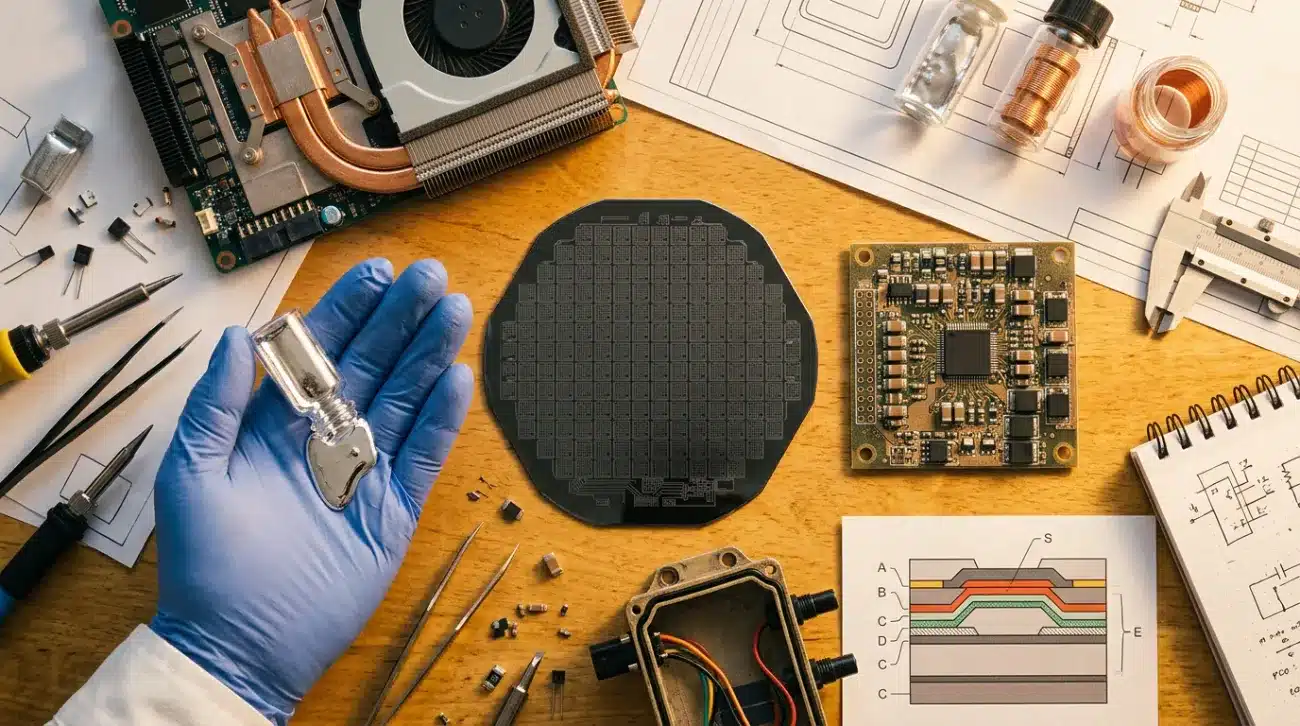
The novelty of a metal melting in a hand can obscure the element’s technical importance. Gallium’s melting point is used for temperature calibration through the International Temperature Scale of 1990, which makes a curiosity into a measurement standard. Wikipedia also notes that compounds of gallium are used in electronics, including in high-speed switching circuits, and that indium gallium nitride is associated with blue and violet light-emitting devices. A science blog likewise calls gallium an essential material in modern electronics, although it gives no specific figures.
Because gallium’s boiling point is high and its vapor pressure low, Los Alamos National Laboratory notes that it can be used in thermometers that measure very high temperatures. The same property that lets it melt in a hand therefore also lets it stay liquid in conditions far hotter than any hand could endure.
The Metal That Gives Way to a Warm Palm

Gallium melts in a hand because its melting point, 29.7646 °C, falls below typical skin temperature, and sources attribute that low value to a crystal structure of loosely interacting atom pairs that sets it apart from aluminium and indium. It is one of only a few metals, alongside mercury, cesium and rubidium, that can be liquid near room temperature, and it stays liquid across an unusually wide range of temperatures. Alloys such as galinstan push melting points lower still, though the reported value for that alloy may reflect supercooling. What looks like a party trick also underpins a formal temperature reference point and a material used in electronics, a reminder that a metal’s behavior in the hand can reflect real differences in atomic structure.


