

Titan: Another Fascinating Moon Revealed by Cassini
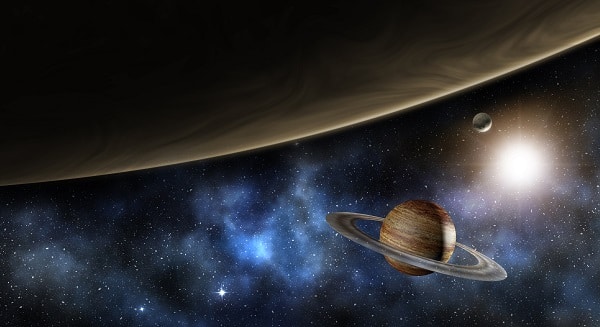
Titan, Saturn’s largest moon and the second-largest moon in our solar system, also captured Cassini’s attention. Notably, Titan is the only known moon with a dense atmosphere and the only celestial body other than Earth known to have liquid on its surface—albeit lakes and rivers of ethane and methane rather than water.
Cassini and its Huygens Probe uncovered the moon’s complex chemistry, with the probe landing on Titan’s surface, marking the most distant landing from Earth ever achieved. The data from Cassini provided compelling evidence of a subsurface ocean of water and ammonia, further boosting the interest of scientists in this intriguing moon.
The Ringed Planet: Saturn’s Rings as Seen by Cassini

No feature is more emblematic of Saturn than its stunning system of rings. Through Cassini’s eyes, these were revealed in unprecedented detail. The spacecraft closely studied the rings’ composition, structure, and dynamics, providing insights into their origin and evolution.
Cassini’s observations showed the rings to be composed mainly of water ice with traces of rocky material, with complex structures including waves and spirals caused by the gravitational influences of Saturn’s moons. The ‘ring rain’ phenomenon, where particles from the rings fall into Saturn’s atmosphere, was also a major finding of the mission.
Cassini’s Grand Finale: The Final Dives

As Cassini’s mission neared its end, its trajectory was adjusted to carry out a series of daring dives between Saturn and its innermost ring. This final mission phase, the ‘Grand Finale,’ allowed for unprecedented measurements and close-up images of Saturn’s atmosphere and ring particles.
These dives culminated in Cassini’s controlled descent into Saturn’s atmosphere on September 15, 2017, bringing the mission to a deliberate end. However, the spacecraft kept transmitting data back to Earth until its final moments, adding further to its extensive legacy of scientific discovery.
The Impact of Cassini: Reflections on a 20-Year Journey

The impact of Cassini’s mission on our understanding of Saturn, its moons, and the wider solar system cannot be overstated. It reshaped knowledge of planetary systems and stirred interest in the astrobiological potential of icy moons. C
assini’s discoveries have inspired a new generation of scientists and will likely influence the direction of future interplanetary missions. Its wealth of data continues to be mined by scientists, contributing to new findings and theoretical developments in planetary science.
Looking Forward: The Future of Saturn Exploration

As Cassini’s mission drew to a close, the gaze of the scientific community turned to the future. The wealth of data and insights provided by the spacecraft continues to inspire new questions and hypotheses about Saturn, its rings, and its moons. The tantalizing possibilities of astrobiology on Enceladus and Titan have made these moons targets for future exploration missions.
The continued analysis of Cassini’s data is set to fuel scientific discovery for many years to come, helping to guide future missions to the Saturnian system. One such mission is the proposed Titan Saturn System Mission (TSSM), a joint endeavor by NASA and the ESA to return to Titan and Enceladus. The Dragonfly mission, another ambitious plan by NASA, aims to launch a drone-like rotorcraft to explore Titan’s diverse environments.
A Fond Farewell to Cassini
As Cassini’s signal faded for the last time, it marked not an end but a legacy of exploration and discovery that continues to inspire. The mission is a testament to human curiosity and the quest for knowledge, having broadened horizons and deepened understanding of the universe.
Cassini’s grand finale might have been a swan song to Saturn, but its echoes reverberate through the halls of science, inspiring a new era of exploration and discovery. It reminds us that there are always new horizons to explore, questions to ask, and discoveries waiting beyond the next celestial body.